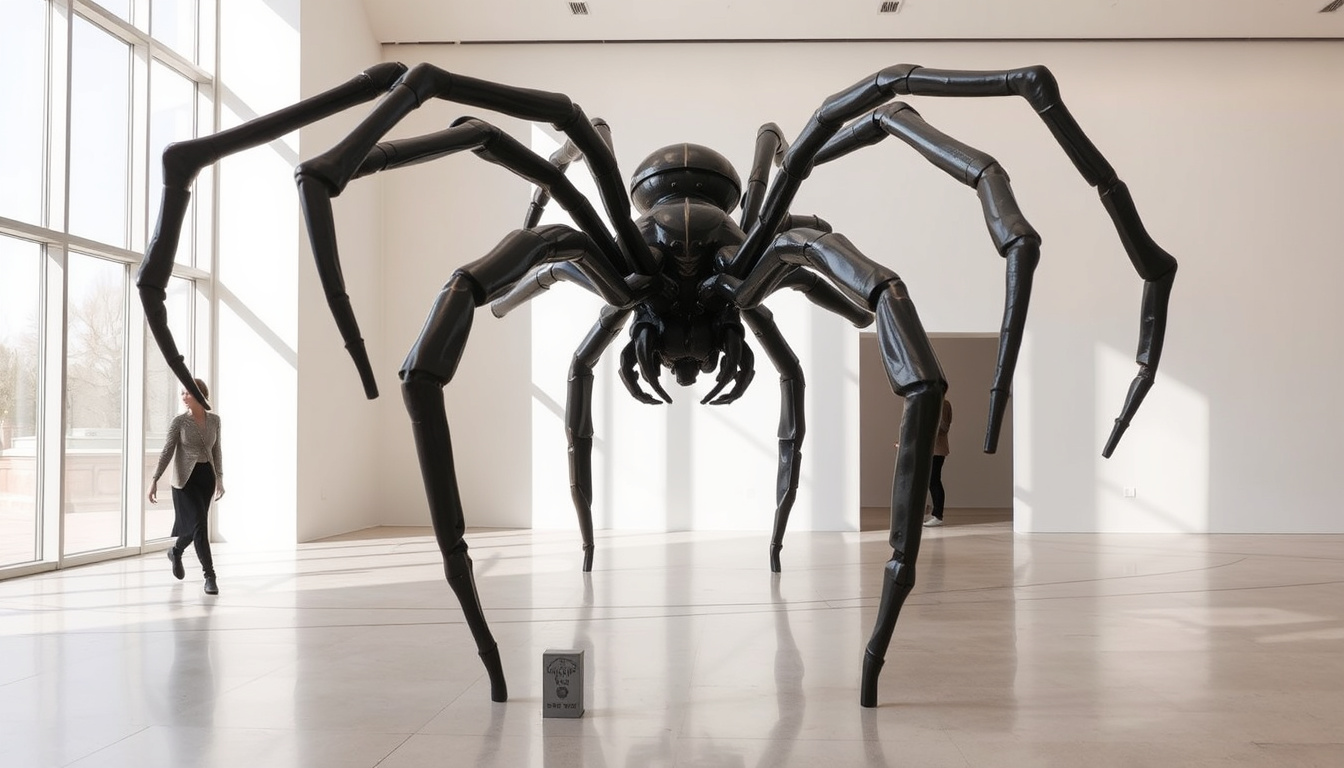
Louise Bourgeois, a French-American artist whose monumental spider sculptures have become icons of modern art, spent seven decades turning personal memory into powerful physical form. Born in Paris in 1911 and active in New York until her death in 2010, she created a body of work that includes large-scale installations, intimate drawings, and soft fabric pieces that explore trauma, motherhood, and the body.
Her most famous creation, the towering spider sculpture Maman (1999), stands over 30 feet tall and has been installed at Tate Modern, the Guggenheim Museum, and other major institutions worldwide. But Bourgeois was far more than the artist who made giant spiders. Her career spanned painting, printmaking, and pioneering work in soft sculpture, always returning to the emotional landscapes of childhood, domesticity, and the unconscious.
This article covers her life, the meaning behind her spider sculptures, her most significant artworks, how to pronounce her name correctly, and where to find her work today.
Who Is Louise Bourgeois?
Louise Joséphine Bourgeois was born on 25 December 1911 in Paris, France. Her parents ran a tapestry restoration workshop, an environment that exposed her to textiles and repair from an early age. She studied at the École du Louvre, Académie Julian, and other Parisian art schools before marrying art historian Robert Goldwater in 1938 and moving to the United States. She raised three sons in New York and became a U.S. citizen in 1951.
Her work repeatedly returned to childhood trauma, domesticity, sexuality, the body, death, and the unconscious. Sources from Tate, Hauser & Wirth, Art21, and the National Museum of Women in the Arts all describe her practice as deeply autobiographical and psychologically driven.
- Born: 1911, Paris, France
- Died: 2010, New York, USA
- Known For: Large-scale sculpture, installation, soft sculpture (spiders, cells)
- Famous Work: Maman (1999) – a giant spider sculpture
Key Insights
- Bourgeois used the spider to represent her mother, embodying traits of weaving, protection, and intelligence.
- Her work blends personal psychological trauma with universal themes of home, memory, and the body.
- She is considered a precursor to feminist art, although she resisted the label.
- Her medium shifted drastically over her 70-year career, from painting to wood, latex, marble, and bronze.
- Her art is often read as a way to externalize, examine, and control emotions through art.
- She was connected to, but not formally part of, Surrealism, Abstract Expressionism, and feminist art.
- Recurring motifs include body parts, houses, cages, and spiders.
Snapshot Facts
| Category | Detail |
|---|---|
| Full Name | Louise Joséphine Bourgeois |
| Nationality | French-American |
| Key Movements | Modern sculpture, Feminist art, Surrealism (affiliated but not defined by) |
| Notable Series | Cells (rooms of sculptural installations), Personnages (wood figures), Spiders (bronze and steel) |
| First Major Retrospective | MoMA, 1982 |
| Venice Biennale | Represented the United States, 1993 |
| First Large-Scale Spider | Brooklyn Museum, 1994 |
| Maman Created | 1999–2001 (Tate Modern Turbine Hall) |
| Major Retrospectives | Tate Modern (2007), Centre Pompidou (2008), MoMA (2017) |
| Died | 31 May 2010, New York City |
What Is the Meaning of Louise Bourgeois’ Spider Sculptures?
The spider is the most recognizable motif in Bourgeois’s work, and its meaning is deeply personal. Maman (1999), her giant spider sculpture, is a tribute to her mother, Joséphine, who was a weaver and seamstress. Bourgeois described the spider as an ode to her mother, linking the creature’s ability to spin webs to her mother’s work with thread and fabric.
Sources describe the spiders as symbols of maternity, seen as both protectors and predators. The title Maman means “mother” in French, a direct linguistic reference that reinforces the work’s autobiographical foundation.
Why Did She Create Spiders?
Bourgeois’s mother died in 1932, an event that deeply affected her. The spider became a way to represent her mother’s qualities: intelligence, patience, and industriousness. In interviews, Bourgeois spoke of the spider as a positive, nurturing figure, though she also acknowledged its ambiguous nature as both a protector and a predator. This duality runs through much of her work.
What Does the Spider Represent in Her Work?
Beyond the personal tribute, the spider functions as a universal symbol of domestic labor, creativity, and maternal ambivalence. The webs evoke both the fragility and strength of family ties. According to Tate and Art21, the spider imagery allowed Bourgeois to explore complex feelings about motherhood, care, and the domestic sphere without resorting to literal representation.
What Are the Most Famous Artworks and Sculptures by Louise Bourgeois?
While Maman is her most widely recognized work, Bourgeois produced a vast and varied oeuvre that includes the Cells series, soft sculptures, and early wooden Personnages. Her work moved from totem-like wooden figures to pliable materials such as latex, and later to rubber, bronze, stone, steel, and marble.
Soft Sculpture and Materials
Bourgeois is closely associated with soft sculpture because she used flexible, tactile materials that evoke bodies, organs, and domestic forms. Later works used latex and other pliable substances, which gave the sculptures a sense of vulnerability and physicality. This material shift supported her themes of memory, fear, fantasy, and psychological release.
Bourgeois began with painting and printmaking, moved to carved wood figures in the 1940s, adopted latex and rubber in the 1960s, and later worked extensively in bronze, marble, and steel. This evolution reflects her ongoing search for the right physical language to express emotional states.
The Cells Series
Created in the 1990s, the Cells are room-sized installations that function as psychological spaces. Each Cell contains objects, furniture, and sculptural elements that create a narrative about confinement, memory, and desire. They are among her most ambitious works and are held in major collections including MoMA and the Centre Pompidou.
Notable Works Beyond Spiders
Other important pieces include Fillette (1968), a latex and fabric sculpture of a male organ that challenges gender norms; The Destruction of the Father (1974), a room-sized installation about family violence; and her many fabric works created late in her career using clothing and household linens from her own life. These works are discussed in detail by Hauser & Wirth and the Easton Foundation.
How Do You Pronounce Louise Bourgeois?
The correct French pronunciation of Louise Bourgeois is given by Tate as [lwiz buʁʒwa]. In English, the surname is commonly pronounced approximately “boor-zhwah.” Both the French and English pronunciations are widely accepted, though the French version is closer to how the artist herself would have said it.
For those unfamiliar with French phonetics, a simple approximation is “Loo-eez Boor-zhwah.” The first name is standard, while the second name requires a soft “zh” sound, as in the middle of “measure.”
Louise Bourgeois: A Life in Key Dates
- 1911: Born in Paris to parents who ran a tapestry restoration workshop.
- 1932: Mother dies; Bourgeois shifts focus to art.
- 1938: Marries art historian Robert Goldwater and moves to New York.
- 1940s–1950s: Begins printmaking and painting; joins American Abstract Artists group.
- 1960s: Develops soft sculpture using latex and rubber (e.g., Fillette).
- 1982: First retrospective at MoMA.
- 1993: Represents the United States at the Venice Biennale.
- 1994: First large-scale Spider installed at the Brooklyn Museum.
- 1999–2001: Creates Maman for the inaugural installation of Tate Modern’s Turbine Hall.
- 2010: Dies in New York at age 98.
What Is Certain and What Remains Debated About Bourgeois?
| Established Information | Information That Remains Unclear |
|---|---|
| Louise Bourgeois was born in 1911 in Paris. | Her exact relationship with Surrealism is debated; she was associated but not an official member. |
| She created the Maman spider sculpture in 1999. | Some psychoanalytic interpretations of Maman vary beyond the documented maternal tribute. |
| Her work is held in major collections including MoMA, Tate, and Centre Pompidou. | The pronunciation of “Bourgeois” varies slightly by region (French vs. English); both are accepted. |
| She repeatedly denied being defined as a feminist artist. | Scholars continue to debate the degree to which her work aligns with feminist art movements. |
Where Can I See Louise Bourgeois’ Artwork Today?
Bourgeois’s work is held in major collections worldwide. The Tate in London holds a version of Maman and presented her 2007 retrospective, which also traveled to the Centre Pompidou in Paris, the Guggenheim Museum in New York, the Museum of Contemporary Art in Los Angeles, and the Hirshhorn Museum and Sculpture Garden in Washington, D.C. Her first major retrospective was at MoMA in 1982, and MoMA continues to display key works from its collection.
The Easton Foundation, which preserves Bourgeois’s legacy, maintains a comprehensive biography and exhibition history. Additional versions of Maman are located in Tokyo, Ottawa, and other cities. Hauser & Wirth, which represents her estate, regularly features her work in gallery exhibitions.
What Books and Quotes Are Associated with Louise Bourgeois?
A 2026 review in The Art Newspaper highlights a new biography that examines Bourgeois’s lifelong revisiting of childhood trauma and her refusal to be neatly categorized. The Easton Foundation, Tate, the Guggenheim, Art21, Hauser & Wirth, the National Museum of Women in the Arts, and Galerie Karsten Greve all provide artist biographies and interpretive materials on her work.
Memorable Quotes
“My childhood has never lost its magic, it has never lost its mystery, and it has never lost its drama.” – Louise Bourgeois
– Art21
“Art is the experience, the re-experience of a trauma.” – Louise Bourgeois
– Hauser & Wirth
These quotations, drawn from interviews and exhibition texts, reveal her conviction that art is a means of processing and controlling emotional experience. They underscore the psychological depth that permeates her entire career.
Why Does Louise Bourgeois Matter Today?
Bourgeois’s influence continues to grow. Her work has shaped contemporary artists such as Tracey Emin and Subodh Gupta, and her sculptures have achieved record prices at auction, with Spider works selling for over $30 million. Museums regularly mount exhibitions of her work, and her thematic concerns with memory, trauma, and the body remain urgent in contemporary discourse. For readers interested in other artist biographies, the article on JMW Turner – Biography, Paintings and Legacy of the Painter of Light offers a parallel deep dive into another major figure in art history. Those interested in museum exhibitions may also find the Cartier V&A Exhibition – Dates, Tickets & Honest Review a useful companion piece on how major institutions present cultural heritage.
Frequently Asked Questions
What does Maman mean?
“Maman” is French for “Mommy.” It is the title of Bourgeois’s famous giant spider sculpture, created in 1999 as a tribute to her mother.
Did Louise Bourgeois only make spider sculptures?
No. She created the Cells series, furniture-like wood sculptures, soft fabric works, and many prints and drawings across seven decades.
Is Louise Bourgeois considered a feminist artist?
Yes, although she was reluctant to define herself by the label, her work addresses female experience, the body, and domestic space.
How tall is the Maman sculpture?
Over 30 feet (9 meters) tall.
Where is the Maman sculpture permanently located?
The original is at Tate Modern in London. Editions exist in Tokyo, Ottawa, and other locations worldwide.
What materials did Bourgeois use for her soft sculptures?
She used latex, rubber, fabric, and other pliable materials that evoke bodies, organs, and domestic forms.
Did Bourgeois study art formally?
Yes. She studied at the École du Louvre, Académie Julian, and other schools in Paris before moving to New York in 1938.
What is the best book about Louise Bourgeois?
A 2026 biography reviewed in The Art Newspaper offers a well-crafted account of her life. The Easton Foundation also provides a comprehensive biography.
What was Bourgeois’s relationship with Surrealism?
She was connected to Surrealist circles but was not a formal member. Her work also intersected with Abstract Expressionism and feminist art.
When did Bourgeois have her first retrospective?
Her first major retrospective was at the Museum of Modern Art (MoMA) in New York in 1982.
Related stories





Isabelle Knight is TV & Streaming Editor at StoryNative.uk, covering television, streaming platforms, broadcast schedules and platform news.