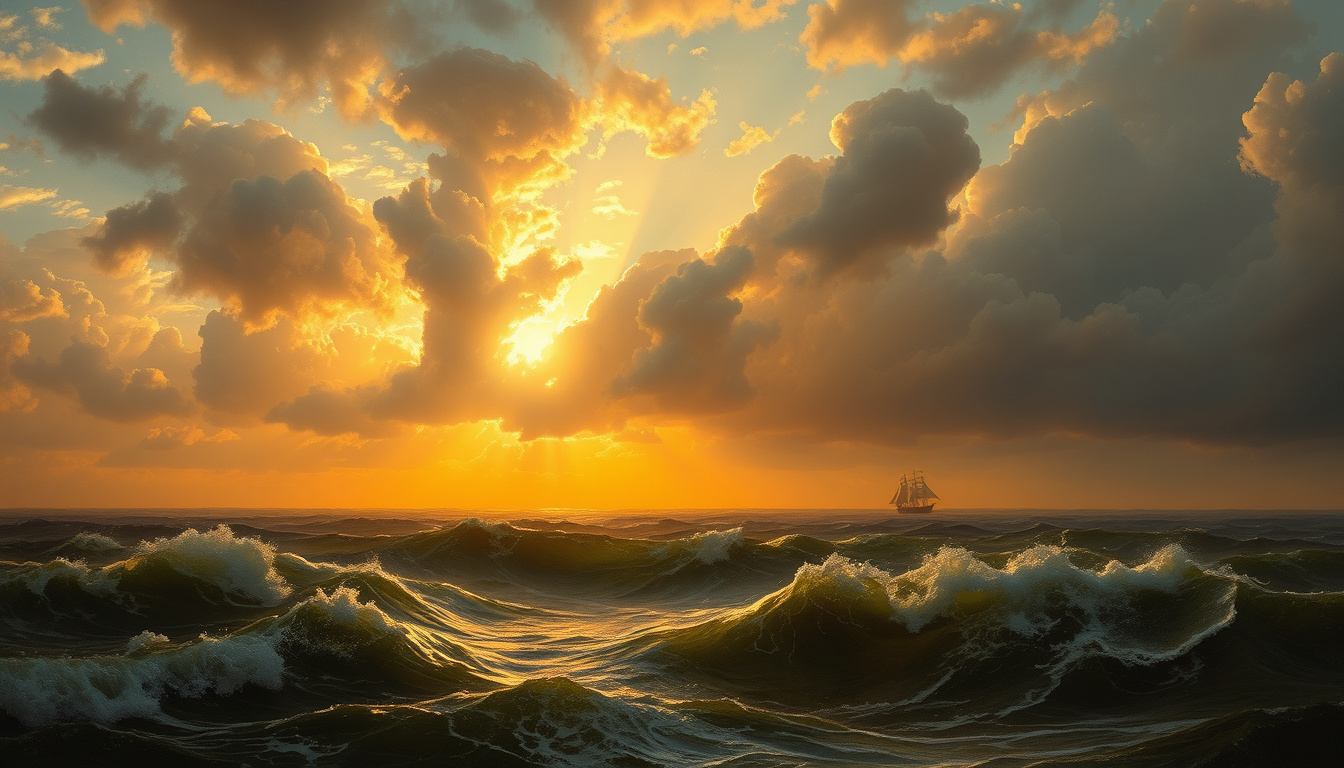

Joseph Mallord William Turner, known as J. M. W. Turner (23 April 1775 – 19 December 1851), was an English Romantic painter, printmaker and watercolourist. He is celebrated for his landscapes, seascapes and dramatic studies of light, colour and atmosphere. Many regard him as one of Britain’s greatest artists and a key precursor to Impressionism.
Born in Covent Garden, London, to a barber and wig‑maker, Turner showed artistic talent early and entered the Royal Academy Schools at age 14 in 1789. His first oil exhibited at the Academy, Fishermen at Sea (1796), won immediate attention. He remained closely associated with the Royal Academy throughout his career.
Turner’s work evolved from topographical precision to expressive, luminous scenes of storms, ships and mountains. His emphasis on brilliant colour earned him the nickname “the painter of light”. He left behind more than 550 oil paintings, some 2,000 watercolours and 30,000 works on paper, most now held at Tate Britain.
Who Was J. M. W. Turner? A Biography of the Painter of Light
Painter of Light, Romantic landscapes, marine scenes
23 April 1775 (probable), London, England
19 December 1851, Chelsea, London
Tate Britain, National Gallery, Royal Academy
Key insights about Turner’s life and work:
- Turner is considered a precursor to Impressionism because of his radical focus on light and atmosphere over precise form. Tate biography
- Despite being a child prodigy who entered the Royal Academy at 14, Turner was fiercely private and rarely discussed his personal life. Royal Academy profile
- His most famous painting, The Fighting Temeraire, was voted Britain’s greatest painting in a 2005 BBC poll. National Gallery
- Turner left the majority of his unfinished works and estate to the British nation, forming the core of the Tate’s collection. Tate collection history
- He produced more than 550 oil paintings and over 30,000 works on paper during his lifetime. Wikipedia
- The critic John Ruskin championed his work from about 1840 onward. National Gallery
Snapshot of Turner’s life and career:
| Attribute | Detail |
|---|---|
| Full Name | Joseph Mallord William Turner |
| Born | c. 23 April 1775, Covent Garden, London |
| Died | 19 December 1851, Chelsea, London |
| Burial | St Paul’s Cathedral, London |
| Nationality | British |
| Education | Royal Academy of Arts (admitted 1789) |
| Movement | Romanticism (precursor to Impressionism) |
| Mediums | Oil on canvas, watercolour, etching, drawing |
| Known For | Expressive colour, turbulent marines, luminous landscapes |
| Notable Works | The Fighting Temeraire, Rain, Steam and Speed, Slavers Throwing Overboard |
| Major Collections | Tate Britain, National Gallery, Royal Academy, Ashmolean Museum |
| Legacy | Bequeathed ~300 oil paintings, 30,000+ sketches to the nation |
What Is J. M. W. Turner Most Famous For? His Artistic Innovations
Why Is He Called the “Painter of Light”?
Turner earned this nickname because of his extraordinary emphasis on brilliant colour and luminosity. His later works increasingly dissolved solid forms into shimmering light and atmosphere. This approach set him apart from earlier landscape painters and directly influenced the Impressionists.
What Techniques Did Turner Use?
Turner worked in both oil and watercolour, often using swift, expressive brushwork. He built up layers of translucent colour to create glowing effects. In his mature period, he abandoned fine detail for bold, sweeping strokes that captured the movement of clouds, waves and steam.
How Did His Style Evolve Over Time?
Early on, Turner painted topographical and architectural subjects with precision. By the 1800s, his style became increasingly dramatic and atmospheric. His late works, such as Rain, Steam and Speed, pushed boundaries of form and colour, earning both praise and criticism from traditional critics.
Turner often sketched outdoors, then elaborated his compositions in the studio. He would sometimes paint with a palette knife or even his fingers to achieve textured, expressive surfaces. Ashmolean Museum
The Fighting Temeraire and Beyond: Turner’s Most Famous Paintings
The Fighting Temeraire (1839)
This painting shows the warship Temeraire being towed to its final berth to be broken up. Turner used the scene to reflect on the passing of the age of sail and the rise of steam power. It is often interpreted as a meditation on mortality and progress.
Rain, Steam and Speed – The Great Western Railway (1844)
Turner captured a locomotive crossing the Maidenhead Railway Bridge in rain and steam. The work is celebrated for its energetic brushwork and almost abstract handling of light and weather. It demonstrates Turner’s fascination with modern technology.
Slavers Throwing Overboard the Dead and Dying – Typhoon Coming On (1840)
Based on a real incident, this painting depicts enslaved people being thrown from a ship. The turbulent sea and fiery sky create an emotionally charged scene. It remains one of Turner’s most controversial works.
Turner reportedly said of his painting of the burning Houses of Parliament: “I did not paint it to be understood, but I wished to show what such a scene was like.” This statement reflects his approach to many late works, where atmosphere overrides narrative.
How Did J. M. W. Turner Influence the Impressionists?
Turner’s focus on light, colour and fleeting atmospheric conditions directly anticipated the goals of Impressionist painters like Monet and Pissarro. Both Monet and Pissarro studied Turner’s work during visits to London and acknowledged his influence.
The Ashmolean Museum notes that “his emphasis on light and colour paved the way for the Impressionists.” This connection is widely accepted by art historians, though Turner died before the first Impressionist exhibition.
How Is Turner Remembered Today?
Turner is revered as a national treasure in Britain. The Clore Gallery at Tate Britain houses the largest collection of his works. He also appears on the current Bank of England £20 note, underscoring his enduring cultural significance.
Turner’s bequest of hundreds of paintings and thousands of sketches to the nation formed the foundation of the modern public art collection at Tate Britain. Tate
Key Dates in Turner’s Life
- 1775 – Born (probable date 23 April) at 21 Maiden Lane, Covent Garden, London.
- 1789 – Admitted to the Royal Academy of Arts at age 14.
- 1790 – First watercolour exhibited at the Royal Academy.
- 1796 – First oil painting exhibited at the Royal Academy (Fishermen at Sea).
- 1802 – Elected full member (Academician) of the Royal Academy.
- 1807 – Appointed Professor of Perspective at the Royal Academy.
- 1819 – First visit to Italy; begins sustained study of Italian light and landscape.
- 1839 – Exhibits The Fighting Temeraire at the Royal Academy.
- 1844 – Exhibits Rain, Steam and Speed.
- 1850 – Final exhibition at the Royal Academy.
- 1851 – Dies 19 December at Chelsea, London.
Sources: Wikipedia, Tate
What Do We Know for Certain About Turner’s Life?
Some details of Turner’s life are well documented, while others remain unclear.
Established Information
- Born 23 April 1775 (though no birth record survives, this date is widely accepted).
- Entered Royal Academy Schools at 14.
- Died 19 December 1851 at Chelsea, London.
- Buried in St Paul’s Cathedral.
- Left more than 30,000 works on paper and about 550 oil paintings.
Information That Remains Unclear
- Exact birth date is accepted but not verified by an official record.
- Cause of death listed as “natural decay”; likely complications from angina or diabetes, but no autopsy was performed.
- Number of works is approximate; some remain in private collections and may be lost.
- Personal relationships were guarded; long‑term partner Sarah Danby is known, but much speculation surrounds his private life.
Source: Britannica
Why Does Turner’s Art Still Matter?
Turner stands at the intersection of 18th‑century landscape tradition and 19th‑century Romanticism. His late works, with their dissolution of form into light and colour, directly anticipated the Impressionist and even Abstract Expressionist movements. He was both celebrated and criticized during his lifetime—praised for genius, condemned for “blots” and “indistinctness.”
His focus on the sublime power of nature, his response to industrialization (as seen in Rain, Steam and Speed), and his artistic independence resonate with contemporary environmental and cultural conversations. His bequest established the foundation for modern public art collections in Britain.
If you are planning a visit to see Turner’s work, major collections are held at Tate Britain (Clore Gallery), the National Gallery, the Royal Academy, and the Ashmolean Museum in Oxford. You may also find interest in the Cartier V&A Exhibition – Dates, Tickets & Honest Review, which touches on museum exhibition culture.
What Did Contemporaries Say About Turner?
“I did not paint it to be understood, but I wished to show what such a scene was like.”
Turner (attributed) on The Burning of the Houses of Lords and Commons
“Turner is perhaps the best-loved English Romantic artist. He became known as ‘the painter of light’…”
National Gallery, London
“His emphasis on light and colour paved the way for the Impressionists.”
Ashmolean Museum, Oxford
What Is Turner’s Lasting Legacy?
Turner reshaped landscape painting by making light and emotion its central subjects. His influence extended well beyond his lifetime, inspiring Impressionists and later abstract painters. His bequest to the nation ensured that future generations could study his revolutionary techniques. For those interested in British heritage, also see the National Trust Near Me – London and Manchester Sites for places connected to Turner’s England.
Frequently Asked Questions
Did Turner have children?
Turner never married, but he had a long‑term relationship with Sarah Danby and is believed to have fathered two daughters, who were raised under the name Danby. The evidence is circumstantial but widely accepted by scholars.
What was Turner’s personality like?
Contemporaries described Turner as eccentric, secretive, blunt, and socially awkward. He was fiercely independent, rarely accepted commissions, and often worked in isolation.
How much is a Turner painting worth?
Turner’s works sell for millions at auction. In 2014, Rome, from Mount Aventine sold for £30.3 million (approx. $47 million). Prices vary by rarity, condition, and provenance.
What was Turner’s relationship with John Constable?
Turner and Constable were contemporaries and rivals in landscape painting. Their relationship was competitive but mutually respectful; both exhibited at the Royal Academy.
Did Turner travel abroad?
Yes. Turner traveled extensively across Europe, including multiple trips to France, Switzerland, Italy, Germany, and the Netherlands. His travels heavily informed his landscapes.
Related stories





Isabelle Knight is TV & Streaming Editor at StoryNative.uk, covering television, streaming platforms, broadcast schedules and platform news.