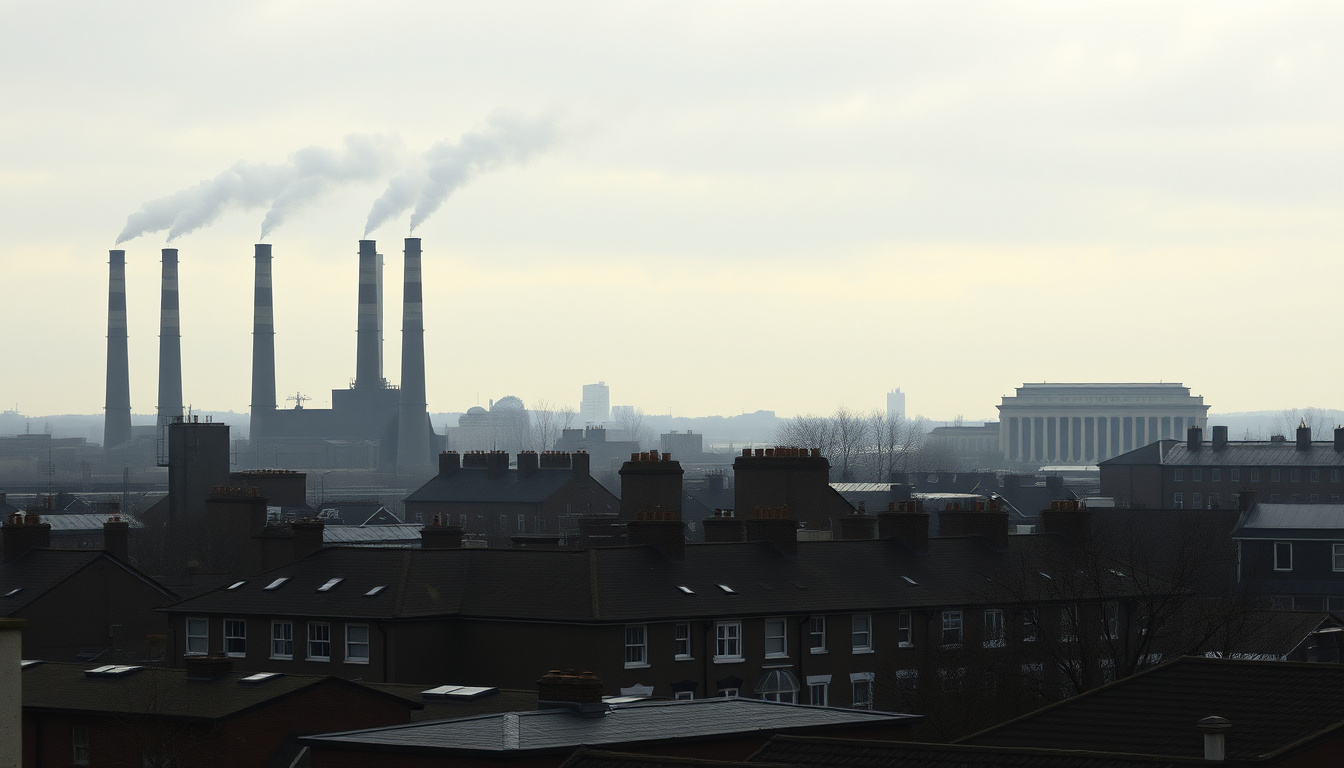
L.S. Lowry remains one of Britain’s most recognisable and beloved artists, known for his distinctive industrial landscapes filled with stick-like figures often called “matchstick men.” His work captures the mills, docks, and football matches of North West England with a style that is both haunting and affectionate. Despite working as a rent collector for most of his life, Lowry created a body of work that continues to draw large audiences and achieve high prices at auction.
Born in 1887 in Stretford, Lancashire, Laurence Stephen Lowry developed an artistic obsession with the industrial environment that surrounded him after his family moved to Pendlebury. He spent decades painting scenes of everyday working life, often from memory, using a deliberately simplified style that critics initially dismissed but later celebrated for its gloomy lyricism and quiet humour.
Lowry died in 1976 at the age of 88, just months before a major retrospective at the Royal Academy cemented his place in British art history. Today, the largest collection of his work is housed at The Lowry museum in Salford Quays, and his paintings regularly sell for millions of pounds at auction.
What is L.S. Lowry Famous For?
L.S. Lowry is famous for his paintings of industrial life in North West England, populated by stylised human figures that have become known as “matchstick men.” His work depicts mills, factory chimneys, terraced streets, football crowds, and dockyards, rendered in a flat, almost naive style that sets him apart from his contemporaries. According to the Tate, Lowry developed a signature approach featuring firmly drawn industrial backgrounds in grey and brown tones against crowds of thin, shadowless figures.
Key Insights About Lowry’s Work and Life
- Lowry is best known for his “matchstick men” and industrial scenes of Pendlebury and Salford, areas he observed while working as a rent collector.
- He worked as a rent collector for four decades, painting only in his spare time, and never became a full-time artist during his life.
- His most expensive painting, Sunday Afternoon (1957), sold for £6.29 million at Christie’s in London in March 2024, making it the highest-priced work of his career.
- The Lowry museum in Salford Quays houses the world’s largest public collection of his work, with over 400 paintings and drawings.
- Lowry’s work is often categorised as naïve art due to its stylised, flat perspective and lack of shadows, a choice he made deliberately.
- He rejected five British honours, including a knighthood in 1968, holding the record for declining the most honours from the British state.
Key Facts About L.S. Lowry
| Fact | Detail |
|---|---|
| Full Name | Laurence Stephen Lowry |
| Born | 1 November 1887, Stretford, Lancashire |
| Died | 23 February 1976, Glossop, Derbyshire |
| Known For | Industrial landscapes, “matchstick men” figures |
| Most Expensive Work | Sunday Afternoon (£6.29 million, 2024) |
| Major Museum | The Lowry, Salford Quays |
Who Was L.S. Lowry? Biography and Full Name
Laurence Stephen Lowry was born on 1 November 1887 in Stretford, Lancashire, to Robert Lowry, an estate agent, and Elizabeth Lowry, an aspiring pianist, as noted by the Christie’s article on ten things to know about the artist. Although the family initially lived in a middle-class suburb, financial difficulties forced them to move to Pendlebury, an industrial area dominated by factory chimneys. That environment became the central subject of his art.
Early Life and Education
Lowry began drawing at the age of eight. He left school at 16 to work as a clerk and later became a rent collector, a job he held for four decades. He attended evening classes at the Manchester Municipal College of Art from 1905 to 1915 and later at the Salford School of Art from 1915 to 1925, as recorded by The Lowry museum. He never trained as a full-time artist; his dual career as a rent collector and painter was only revealed to the public after his death.
Where Did Lowry Live and Work?
Lowry lived most of his life in the industrial towns of Pendlebury and Salford in Greater Manchester. He worked as a rent collector for the Pall Mall Property Company, walking through working-class neighbourhoods to collect rents. Those daily walks gave him an intimate view of industrial life, which he later translated onto canvas. He was a solitary, semi-reclusive figure who kept his professional and artistic lives strictly separate, according to The Art Story.
Lowry worked as a rent collector for about 40 years while painting in his spare time. He never became a full-time artist during his life, and the public only learned about his day job after his death in 1976.
When Did L.S. Lowry Die?
L.S. Lowry died on 23 February 1976 at Woods Hospital in Glossop, Derbyshire, at the age of 88. According to the Tate, the cause of death was pneumonia following a stroke at his home. He was not registered with a doctor and died at the hospital after being taken there.
Circumstances Around His Death
Lowry’s death came just months before a major retrospective of his work opened at the Royal Academy in London in September 1976. That exhibition became one of the busiest shows of the 20th century, drawing huge crowds and cementing his posthumous reputation. He was 88 years old and had remained active as a painter until near the end of his life.
Posthumous Recognition
After his death, Lowry’s work gained even greater recognition. A major retrospective at Tate Britain in 2013 and his first solo exhibition outside the UK, held in Nanjing, China in 2014, have extended his international reach, as documented by the Tate.
What Is the Most Expensive L.S. Lowry Painting?
The most expensive L.S. Lowry painting ever sold is Sunday Afternoon (1957), which fetched £6.29 million at Christie’s in London in March 2024. According to Wikipedia and Christie’s, the work is one of Lowry’s largest canvasses and represents the highest price achieved for any of his paintings at auction.
Other Notable Paintings and Their Value
Lowry’s work has consistently performed well at auction. Going to the Match (1953), a famous depiction of football fans heading to a match at Bolton Wanderers’ Burnden Park, is one of his best-known works. Coming from the Mill (1930) is considered his most characteristic mill scene and is held in the Lowry Collection. Cranes and Ships, Glasgow Docks (1947) was acquired by Glasgow City Council for the Riverside Museum in 2005 for £198,400.
While Sunday Afternoon set a new record in 2024, some earlier reports cited The Football Match as selling for £7.8 million in 2011. Auction prices for Lowry’s work have fluctuated, but demand remains strong, with major pieces regularly exceeding £1 million. The most recent record is now firmly held by Sunday Afternoon.
Beyond the record-breaking Sunday Afternoon, key paintings include Going to the Match (1953), Coming from the Mill (1930), Industrial Landscape (1955), and Cranes and Ships, Glasgow Docks (1947). Each exemplifies Lowry’s signature industrial style and his affectionate observation of everyday life.
What Is the LS Lowry Museum?
The Lowry is a purpose-built art gallery and museum located on Salford Quays in Greater Manchester. It houses the world’s largest public collection of L.S. Lowry’s work, with more than 400 paintings and drawings permanently on display, as noted by the Tate and The Black Acre Times.
Where Is the Lowry Museum Located?
The museum is at Salford Quays, Manchester, within the MediaCityUK development. It opened in 2000 and has since become a major cultural destination, drawing visitors from across the UK and internationally. The building also hosts theatre and performance spaces alongside its gallery.
What Else Is at The Lowry?
In addition to the Lowry collection, the venue presents rotating exhibitions of modern and contemporary art, as well as live performances. It serves as a hub for the arts in the North West and has been instrumental in cementing Lowry’s legacy as a regional and national treasure.
What Were the Key Milestones in L.S. Lowry’s Life?
Lowry’s life spanned nearly nine decades, during which he transitioned from a little-known clerk and rent collector to one of Britain’s most recognised artists. The timeline below highlights the major events, based on records from the Tate, The Lowry museum, and Wikipedia.
- 1887: Born Laurence Stephen Lowry in Stretford, Lancashire.
- 1905: Left school and began working as a clerk; started evening classes at Manchester Municipal College of Art.
- 1910: Continued art studies at Salford School of Art while working as a rent collector.
- 1920s: Developed his signature industrial landscape style, focusing on Pendlebury and Salford.
- 1932: Held his first solo exhibition at the Manchester Art Gallery.
- 1950s: Gained national recognition and received honorary degrees.
- 1976: Died on 23 February at age 88 in Glossop, Derbyshire.
- 2000: The Lowry museum opened in Salford Quays, housing the largest collection of his work.
What Is Certain and What Remains Unclear About Lowry?
While the broad outlines of Lowry’s life are well documented, some details remain uncertain or are the subject of limited public knowledge. The table below separates established facts from areas where information is less clear.
| Topic | Status | Detail |
|---|---|---|
| Date of birth | Certain | 1 November 1887, confirmed by birth records. |
| Date of death | Certain | 23 February 1976, confirmed by death records. |
| Full name | Certain | Laurence Stephen Lowry. |
| Henry Lowry connection | Uncertain | Limited search data; may refer to a relative or a misattribution. No widely known direct connection exists in major biographies. |
| Don Quixote / Macbeth works | Uncertain | Low search volume; may refer to lesser-known or attributed works that are not firmly established in the main catalogue. |
How Does Lowry’s Work Fit Into British Art History?
L.S. Lowry occupies a unique place in British art. His work is often compared to visual documentation of the Industrial Revolution, capturing a way of life that was disappearing even as he painted it. Critics initially labelled him a “naïve Sunday painter,” but his work is now celebrated for what the Tate calls its “gloomy lyricism” and apolitical, affectionate humour regarding ordinary life.
His “matchstick men” style was deliberately simplified. Lowry painted crowds of people as thin, stick-like figures with no shadows, set against grey and brown industrial backdrops. This approach was initially dismissed by the art establishment but later embraced as uniquely British and deeply evocative of a specific time and place.
The Lowry museum in Salford has cemented his legacy as both a regional and national treasure. Market demand for his work remains strong, with record prices at auction reflecting continued interest from collectors and institutions alike. His place in British art history is now secure, with major retrospectives at Tate Britain and the Royal Academy ensuring his work reaches new generations.
Which Sources Offer the Most Reliable Information on Lowry?
For readers seeking authoritative information on L.S. Lowry, several institutional sources provide well-researched and verified content. The Tate holds a significant collection of his work and publishes a detailed biography. The Lowry museum in Salford offers the most comprehensive overview of his life and legacy, alongside information about visiting the collection.
“Lowry developed a distinctive style featuring firmly drawn industrial backgrounds against crowds of people rendered as thin, stick-like figures with no shadows, known as ‘matchstick men.’”
— Tate, L.S. Lowry 1887–1976
The Wikipedia entry on Lowry provides a well-cited encyclopedic overview, while Christie’s offers market-focused insights with auction context. For those interested in the broader artistic context, The Art Story provides critical analysis of his style and influence.
“Lowry is celebrated for his ‘gloomy lyricism’ and apolitical, affectionate humour regarding ordinary life.”
— Tate, L.S. Lowry 1887–1976
What Is L.S. Lowry’s Lasting Legacy?
L.S. Lowry’s legacy endures through his unmistakable visual language of matchstick men and industrial landscapes, which continue to resonate with audiences worldwide. The largest public collection of his work at The Lowry in Salford ensures that new generations can experience his art firsthand. His paintings also appear regularly at major auction houses, with prices reflecting his status as one of Britain’s most important 20th-century artists. For readers interested in other figures from the industrial North West, the biography of Fred Dibnah – Biography, Death, Wives, and Net Worth offers a complementary story of industrial heritage. Those drawn to the lives of British artists may also find value in Charlie Mackesy – Biography, Books, and Inspiring Quotes.
Frequently Asked Questions About L.S. Lowry
Are there books about L.S. Lowry?
Yes, several biographies and art books cover Lowry’s life and work, including The Life of L.S. Lowry by Shelley Rohde and Lowry: A Visionary Artist by Michael Howard.
Who was Henry Lowry in relation to L.S. Lowry?
Henry Lowry is a low-volume search term; it may refer to a relative or a misattribution. There is no widely known direct connection in major biographies.
What is the LS Lowry Museum?
The Lowry is a museum and arts venue in Salford Quays, Greater Manchester, housing the world’s largest public collection of L.S. Lowry’s works.
Where did L.S. Lowry live and work?
Lowry lived in Pendlebury and Salford, Greater Manchester, and worked as a rent collector in the industrial areas that became the subjects of his paintings.
What style of art is L.S. Lowry known for?
He is known for a naïve, modern British style featuring flat perspectives, grey and brown industrial tones, and stylised human figures without shadows.
What is L.S. Lowry’s full name?
His full name is Laurence Stephen Lowry. He was born on 1 November 1887 in Stretford, Lancashire.
How old was L.S. Lowry when he died?
Lowry was 88 years old when he died on 23 February 1976 at Woods Hospital in Glossop, Derbyshire.
What is Lowry’s most expensive painting?
Sunday Afternoon (1957) sold for £6.29 million at Christie’s in London in March 2024, making it the most expensive Lowry painting ever sold.
Did L.S. Lowry reject honours?
Yes, he rejected five British honours, including a knighthood in 1968. He holds the record for declining the most British honours.
What did Lowry paint besides industrial scenes?
He also painted seascapes from the 1940s, portraits, unpopulated landscapes, and a series of unpublished “marionette” works discovered after his death.
Related stories




Leon Carter is Celebrity & Royals Editor at StoryNative.uk, covering celebrity news, royal coverage and entertainment personalities.