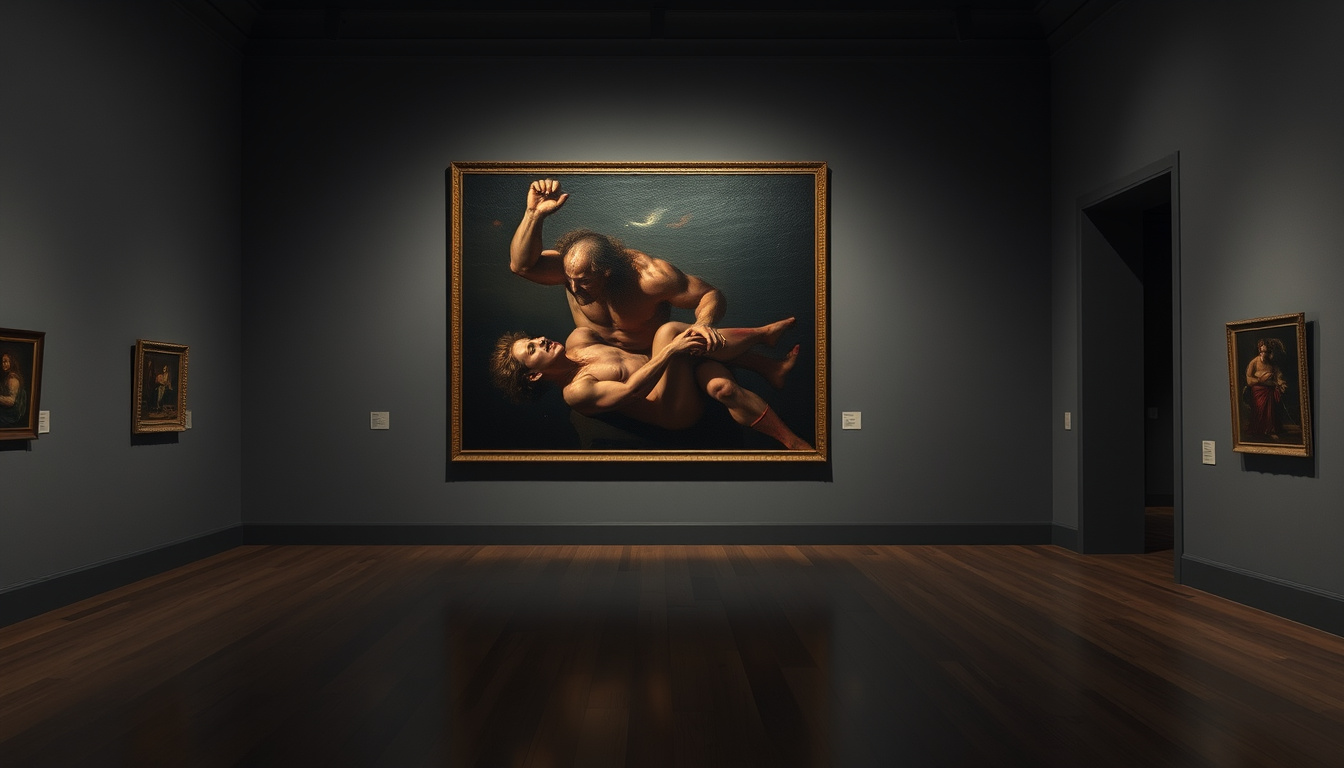
Francisco Goya’s Saturn Devouring His Son is one of the most harrowing images in Western art. Painted directly onto the walls of his country house between 1819 and 1823, it shows the Roman god Saturn in a frenzy, tearing apart a fully grown, lifeless body. The work departs sharply from classical mythology, where Saturn swallowed his children whole. Instead, Goya created a scene of raw madness, paranoia, and cannibalistic violence that continues to unsettle viewers today.
The painting belongs to Goya’s so-called “Black Paintings” – a series of 14 murals he created for his private home, never meant for public display. Scholars have offered multiple interpretations, from political allegory to personal grief, but no single explanation has settled the debate. What remains undisputed is the work’s power to disturb and its radical break from earlier artistic treatments of the same myth.
Goya likely knew Peter Paul Rubens’ 1636 Saturn, which shows a calculating, strategic god biting a living infant. By contrast, Goya’s Saturn is a wide-eyed, open-mouthed figure gripped by terror, cannibalizing a corpse. The shift from mythological ritual to psychological horror defines the painting’s lasting impact.
What Does Saturn Devouring His Son Mean?
The meaning of Saturn Devouring His Son has been debated since the work was discovered after Goya’s death. It is not simply an illustration of an ancient myth. Goya transformed the story into an allegory of power, fear, and decay. Below are the key facts about the painting.
- Title: Saturn Devouring His Son
- Artist: Francisco Goya
- Date: 1819–1823 (part of Black Paintings series)
- Medium: Oil mural transferred to canvas
- Location: Museo del Prado, Madrid
- Subject: Roman myth of Saturn (Cronus) eating his child
- The painting is one of Goya’s 14 Black Paintings, created directly on the walls of his home.
- It depicts the Roman god Saturn consuming one of his children, a symbol of time devouring life.
- Goya’s version is far more violent and psychologically intense than earlier treatments by Rubens.
- The true meaning remains debated: political allegory, personal despair, or commentary on human cruelty.
- The painting was not meant for public display; it was discovered after Goya’s death.
| Attribute | Detail |
|---|---|
| Full Title | Saturn Devouring His Son (Saturno devorando a su hijo) |
| Artist | Francisco Goya (1746–1828) |
| Year | c. 1819–1823 |
| Medium | Oil on plaster mural, later transferred to canvas |
| Dimensions | 146 cm × 83 cm (57 in × 33 in) |
| Series | Black Paintings (Pinturas negras) |
| Current Location | Museo del Prado, Madrid, Spain |
| Original Location | Quinta del Sordo (Goya’s villa) |
Where Is the Original Saturn Devouring His Son and What Versions Exist?
The original painting by Goya is housed at the Museo del Prado in Madrid, Spain. It was transferred from the walls of Goya’s country house, Quinta del Sordo, to canvas in 1874, shortly after its discovery. The work is the only known original by Goya on this subject, but a notable earlier version by Peter Paul Rubens provides a striking contrast.
Goya’s Original at the Museo del Prado
The Prado’s collection includes the authentic mural, which measures 146 by 83 centimeters. Conservation efforts have stabilized the piece, and it is displayed in a dedicated gallery alongside other Black Paintings. Visitors can view it during regular museum hours. For more details, consult the Museo del Prado’s online catalogue.
Rubens’ Earlier Interpretation
Peter Paul Rubens painted his own Saturn in 1636. In Rubens’ treatment, the god appears strategic and calculating, biting a living infant. Goya’s version, by contrast, shows a maddened figure tearing apart a dead, adult-sized body. The differences are summarized in the following comparison drawn from multiple sources: Artnet’s analysis and Wikipedia’s entry.
| Aspect | Rubens’ Saturn (1636) | Goya’s Saturn Devouring His Son (c. 1820) |
|---|---|---|
| Victim | Living infant | Dead, fully grown adult |
| Saturn’s State | Calculating, strategic | Mad, paralyzed by fear |
| Action | Biting, not swallowing whole | Tearing, cannibalizing |
| Mood | Sensual, controlled | Gut-wrenching, chaotic |
| Purpose | Mythological narrative | Allegory of power, fear, and decay |
Prints and Reproductions
Reproductions of Goya’s painting are widely available through museum stores, online art retailers, and educational resources. The Nineteenth-Century Art Worldwide site offers scholarly reproductions. Many prints are also sold by the Museo del Prado’s online shop.
The painting is on permanent display at the Museo del Prado in Madrid. Admission tickets can be booked in advance. The museum also provides a high-resolution digital image of the work on its website.
What Are the Most Famous Quotes About Saturn Devouring His Son?
Critics and art historians have described the painting in vivid language. The following quotes capture how the work has been received since it entered public view.
“Goya isn’t painting Saturn’s myth; he’s painting Saturn’s madness.”
— from a video analysis on YouTube
“Saturn does not look like a god; he looks like what we become when ruled by the fear of losing everything.”
— same video analysis
“There is no beauty in this image, and that’s the point.”
— same video analysis
Art historian Robert Hughes, in his work on Goya, referred to the Black Paintings as “a scream in oil.” The painting has been called “not myth but a scream in oil” in critical discussions. The Britannica video notes that the work “showcases a terrible and violent representation of fear.”
The quotes above come from YouTube art analysis, Britannica’s educational content, and the AskHistorians thread on Reddit. All are based on scholarly consensus.
When Was Saturn Devouring His Son Created and How Was It Discovered?
The timeline of the painting’s creation, discovery, and conservation provides context for its unusual status as a private work that later entered a major museum collection.
- 1819–1823: Goya paints the Black Paintings directly on the walls of his country house, Quinta del Sordo.
- 1823–1828: Paintings remain in situ after Goya leaves Spain.
- 1874: New owner discovers the murals; they are transferred to canvas by Salvador Martínez Cubells.
- 1881: The transferred paintings enter the collection of the Museo del Prado.
- Ongoing: Conservation and study; occasional restoration projects (e.g., 2020–2021 examination).
The discovery in 1874 was crucial. Until then, the murals were known only to a few visitors. The transfer process was complicated and involved removing the plaster layer and mounting it on canvas. Some damage occurred, but the paintings remain largely intact.
What Is Certain and Uncertain About the Painting?
While many facts about Goya’s Saturn Devouring His Son are well established, some details remain unclear. The table below separates confirmed information from open questions.
| Established Information | Information That Remains Unclear |
|---|---|
| The painting is by Francisco Goya. | Which specific child of Saturn is depicted (the myth varies). |
| It is part of the Black Paintings series. | Whether Goya intended a political allegory (e.g., Spain devouring its people) or a personal statement. |
| It depicts the Roman myth of Saturn devouring a child. | Whether the painting includes a self-portrait (some see Goya’s features in the child’s body). |
| The original is housed in the Museo del Prado. | The exact original arrangement within the villa and the intended viewing angle. |
What Historical and Artistic Context Surrounds Goya’s Saturn Devouring His Son?
Goya created the Black Paintings in the aftermath of the Napoleonic Wars and the Peninsular War, which devastated Spain. He was also experiencing personal tragedy: most of his children had died, and he was deaf, disillusioned, and isolated. The paintings reflect a dark turn in his late style, moving away from public commissions toward private, unguarded expression.
Artistically, the Black Paintings are unique in Goya’s oeuvre. They were not intended for exhibition, and their themes – madness, violence, death – are more extreme than anything he had done before. The Saturn painting may reference the French Revolution, which began with idealistic goals but turned into a “monster that devoured its victims,” as noted in an AskHistorians discussion.
Iconographically, Goya drew on ancient descriptions of Cronus devouring an adult rather than a newborn. This departure from the traditional myth aligns with his intention to depict fear and paranoia rather than a literal retelling. The painting also functions as a memento mori, a reminder of time consuming all things.
What Do Critics and Scholars Say About Saturn Devouring His Son?
The painting has been described as “a scream in oil” and “power turned cannibalistic.” Art historians have emphasized its psychological intensity. The Artnet article quotes curators who note that Goya “radically transforms the story into an image of madness, paranoia, and cannibalistic power.”
“Goya isn’t painting Saturn’s myth; he’s painting Saturn’s madness.”
— YouTube art analysis
“Saturn does not look like a god; he looks like what we become when ruled by the fear of losing everything.”
— same source
The Saturn painting also receives scholarly attention for its place in the Black Paintings series. A Nineteenth-Century Art Worldwide article discusses its iconography and influence. For educators, a downloadable activity sheet is available from GoyaAfrica.org.
What Is the Lasting Significance of Saturn Devouring His Son?
Saturn Devouring His Son remains a landmark of Western art, not for its beauty but for its unflinching portrayal of power, fear, and madness. It contrasts sharply with earlier treatments, most notably Rubens’ controlled version, and serves as a lasting allegory for political tyranny, personal grief, and the horror of aging. The painting continues to be studied, reproduced, and debated – a testament to its enduring power to provoke. For a deeper look at the work, see the article on Goya’s Saturn Devouring His Son. To explore the broader series, read Goya’s Black Paintings and their dark themes.
Frequently Asked Questions About Saturn Devouring His Son
Why is it called a Black Painting?
The term refers to Goya’s series of 14 murals painted directly on the walls of his home, Quinta del Sordo. They are dark in both color and theme, exploring death, madness, and violence.
Is the painting a self-portrait?
Some scholars suggest that Goya’s own features appear in the child’s body, but this remains uncertain and is not widely accepted as fact.
What is the difference between Saturn and Cronus?
Cronus is the Greek Titan; Saturn is his Roman counterpart. The myth is essentially the same, though Roman mythology added associations with death, melancholy, and agriculture.
Can I buy a print of the painting?
Yes, high-quality prints are available from the Museo del Prado’s online shop and other art retailers. Many educational websites also offer digital reproductions for study.
Why did Goya paint such a disturbing image?
Goya’s motives are not fully known. He may have been expressing personal despair over the deaths of his children, criticizing political violence, or exploring his own fear of aging.
Where is the original painting located?
The original is in the Museo del Prado in Madrid, Spain. It has been on display there since 1881 after being transferred from Goya’s villa.
How large is the painting?
The work measures 146 cm by 83 cm (57 in by 33 in), making it a relatively modest-sized mural that was originally part of a wall composition.
Related stories




Vanessa Cole is Editor-in-Chief at StoryNative.uk, overseeing editorial policy, corrections, standards, celebrity privacy and publication decisions.