
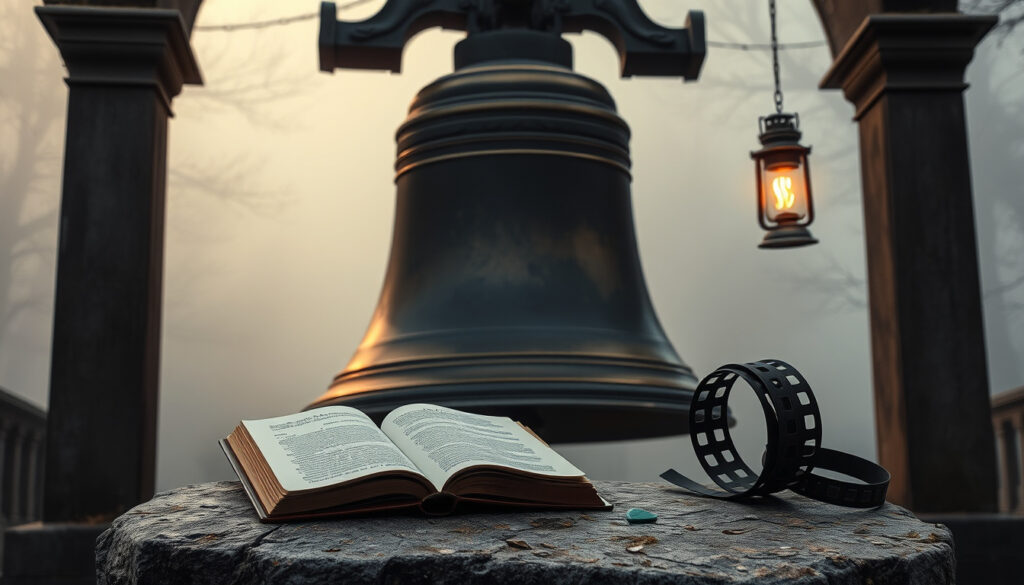
Few phrases have traveled so far across literature, music, and film as “for whom the bell tolls.” It appears on the page of a 17th-century meditation, in the title of Ernest Hemingway’s classic war novel, in a blistering Metallica track, and on the poster of a 1943 Hollywood film. Each version draws from the same core idea: no one dies alone, and every loss diminishes everyone.
The phrase originates with John Donne, the English poet and cleric who wrote in 1624 that “never send to know for whom the bell tolls; it tolls for thee.” Ernest Hemingway borrowed those words for his 1940 novel about an American demolitions expert fighting with Republican guerrillas in the Spanish Civil War. Decades later, Metallica turned the title into a heavy‑metal anthem. The 1943 film adaptation, starring Gary Cooper and Ingrid Bergman, brought the story to an even wider audience.
What is ‘For Whom the Bell Tolls’ by Ernest Hemingway about?
Hemingway Novel
1940 novel set during the Spanish Civil War, follows American Robert Jordan.
John Donne Poem
17th‑century meditation on mortality; source of the famous “no man is an island” line.
Metallica Song
1984 track from Ride the Lightning inspired by the novel and poem.
1943 Film
Starring Gary Cooper and Ingrid Bergman, based on Hemingway’s novel.
The novel follows Robert Jordan, a young American demolitions expert who joins a Republican guerrilla band during the Spanish Civil War. His mission: blow up a bridge behind enemy lines to support a planned offensive. Over the course of a few days, Jordan interacts with the band’s leader Pablo, the fierce Pilar, and the young woman María, with whom he falls in love.
Key insights
- The phrase originates from John Donne’s 1624 poem, emphasizing interconnectedness and shared mortality.
- Ernest Hemingway adopted the line as the title of his 1940 novel, linking it to the collective tragedy of war.
- Metallica’s song draws heavily from both the poem and the novel, but personalizes the battle experience.
- The 1943 film adaptation is a faithful but condensed version of the novel, receiving critical acclaim.
- Lesser‑known works like Jaysea Lynn’s book and a Bee Gees cover (unconfirmed) show the phrase’s enduring cultural reach.
| Work | Creator | Year | Medium | Key Theme |
|---|---|---|---|---|
| Devotions upon Emergent Occasions | John Donne | 1624 | Poetry | Interconnectedness of humanity |
| For Whom the Bell Tolls (novel) | Ernest Hemingway | 1940 | Novel | War, love, sacrifice |
| For Whom the Bell Tolls (film) | Sam Wood (director) | 1943 | Film | Adaptation of novel |
| For Whom the Bell Tolls (song) | Metallica | 1984 | Music | Death, battle, the tolling bell |
| For Whom the Bell Tolls (book) | Jaysea Lynn | Unknown | Novel | Likely inspired by the phrase |
Hemingway drew on his own experience covering the Spanish Civil War for the North American Newspaper Alliance. The novel is widely regarded as his most direct fictional treatment of that conflict. A major scene in which Pilar recounts executions in her village is linked to real events that took place in Ronda in 1936, though Hemingway later claimed he had fabricated it. The source material was in fact connected to real events there, according to Wikipedia.
What is the meaning of the ‘For Whom the Bell Tolls’ poem by John Donne?
The “poem” people often refer to is actually a prose meditation titled Devotions upon Emergent Occasions, written by John Donne in 1624. Its most famous passage begins “No man is an island, entire of itself; every man is a piece of the continent, a part of the main.” The line “never send to know for whom the bell tolls; it tolls for thee” concludes that thought.
Donne’s meditation argues that the death of any person diminishes everyone because humanity is connected. That idea became the philosophical foundation for Hemingway’s novel and, later, Metallica’s song.
The full text is widely available online. The insight has resonated across centuries because it asks a universal question: whose death matters? Donne’s answer is that every death matters to everyone.
What are the lyrics and meaning of Metallica’s ‘For Whom the Bell Tolls’?
Released in 1984 on Ride the Lightning, Metallica’s song takes the title and the central metaphor of the bell and applies them to an individual soldier’s experience in battle. The lyrics describe a man facing death: “Take a look to the sky just before you die, it’s the last time you will.” Unlike Donne’s meditation or Hemingway’s novel, the song focuses on the personal, internal reckoning with mortality.
The heavy‑metal track became one of Metallica’s most iconic pieces and introduced the phrase to a generation that might never have read the novel or the poem. The guitar riff, played in E minor with palm muting, is widely studied by musicians. Tabs are available on sites such as Ultimate Guitar.
Is there a movie adaptation of ‘For Whom the Bell Tolls’?
Yes. Paramount Pictures released a film adaptation in 1943, directed by Sam Wood. Gary Cooper played Robert Jordan, and Ingrid Bergman played María. The film condenses the novel’s plot but stays faithful to its core story. It received critical acclaim and several Academy Award nominations. The movie helped cement the phrase in popular culture, alongside the novel and the later Metallica song.
What other books or songs use the title ‘For Whom the Bell Tolls’?
Several lesser‑known works share the title. Jaysea Lynn published a novel with the same name, though details are sparse and it may be a self‑published work.
Some sources mention that the Bee Gees recorded a song titled “For Whom the Bell Tolls,” but there is no confirmed official release. It may be a cover by Robin Gibb or a misattribution. This remains unverified.
The enduring power of the phrase is evident in its continued use across media. Each adaptation reframes the “bell” as a metaphor for loss—communal, political, or personal.
Timeline: How did the phrase evolve through the centuries?
- 1624: John Donne publishes Devotions upon Emergent Occasions, containing the line “for whom the bell tolls.”
- 1940: Ernest Hemingway publishes his novel For Whom the Bell Tolls, set during the Spanish Civil War.
- 1943: Paramount Pictures releases the film adaptation starring Gary Cooper and Ingrid Bergman.
- 1984: Metallica releases “For Whom the Bell Tolls” on the album Ride the Lightning.
- 2000s+: Various lesser‑known works, such as Jaysea Lynn’s novel, continue to use the title.
What is certain and what remains unclear about the phrase?
| Claim | Details |
|---|---|
| The phrase comes from John Donne. | Published text, widely cited. |
| Hemingway’s novel title is taken directly from Donne’s poem. | Hemingway’s epigraph includes the poem excerpt. |
| Metallica’s song is about war and death. | Lyrics reference battle and the bell; band interviews confirm. |
| The Bee Gees recorded a song with the same title. | No confirmed official release; may be a cover or misattribution. Unverified. |
| Jaysea Lynn’s book is a direct reference. | Limited public information; may be self‑published. |
How did the phrase gain such cultural weight?
The phrase’s power lies in its shift from personal meditation (Donne) to collective tragedy (Hemingway) to individual internal battle (Metallica). Each adaptation reframes the “bell” as a metaphor for loss—communal, political, or personal. Hemingway’s novel is considered a classic of war literature, while Metallica’s song broadened the phrase’s reach to new generations. The enduring relevance stems from its universal question: whose death matters?
What do key sources say about the phrase?
“No man is an island, entire of itself; every man is a piece of the continent, a part of the main… And therefore never send to know for whom the bell tolls; it tolls for thee.”
John Donne, Devotions upon Emergent Occasions (1624)
“He lay on the hill, his legs in the air, and he saw the red patches of blood on his shirt and he thought, ‘It is for me that the bell tolls.’”
Ernest Hemingway, For Whom the Bell Tolls (1940)
“Take a look to the sky just before you die, it’s the last time you will.”
Metallica, “For Whom the Bell Tolls” (1984)
Where can you explore more about the novel, film, and song?
The phrase “For Whom the Bell Tolls” unites a 17th‑century meditation, a 1940 war novel, a 1943 film, and a 1984 heavy‑metal song into a single thread of human connection and mortality. Each version asks the same question in a different voice. For further reading, you can explore other classic novels adapted to film and read more about Metallica’s discography.
Frequently Asked Questions
How to play ‘For Whom the Bell Tolls’ on guitar?
The main riff is played in E minor with palm muting; tabs are widely available on sites like Ultimate Guitar.
What is ‘For Whom the Bell Tolls’ book by Jaysea Lynn?
A lesser‑known novel that uses the same title; details are sparse, possibly self‑published.
Did the Bee Gees really record a song called ‘For Whom the Bell Tolls’?
There is no confirmed official recording; some unverified sources list a cover performed by Robin Gibb, but it is not widely recognized.
Is ‘For Whom the Bell Tolls’ a true story?
Hemingway’s novel is fiction, though it is inspired by his experiences during the Spanish Civil War.
What is the meaning of the Metallica song?
The song portrays a soldier facing death in battle, using the bell as a metaphor for personal mortality and the finality of life.
Why is the phrase “for whom the bell tolls” so famous?
It appears in a classic poem, a major novel, a successful film, and a iconic heavy‑metal song, each reinforcing the theme of shared humanity.
Is there a full text of John Donne’s poem?
Yes, the full meditation is available on the Poetry Foundation website.
Who wrote the original phrase?
John Donne, an English poet and cleric, wrote it in 1624 as part of Devotions upon Emergent Occasions.
Does the 1943 film follow the novel closely?
It condenses the plot but remains faithful to the core story and characters, earning critical acclaim.
What is the setting of Hemingway’s novel?
The story takes place during the Spanish Civil War, in the mountains near Segovia, over a period of about four days.
Related stories




Adam Pryor is Managing Editor at StoryNative.uk, running the daily news list, the publishing schedule and newsroom workflow.